
The Intersection of Faith and Public Policy
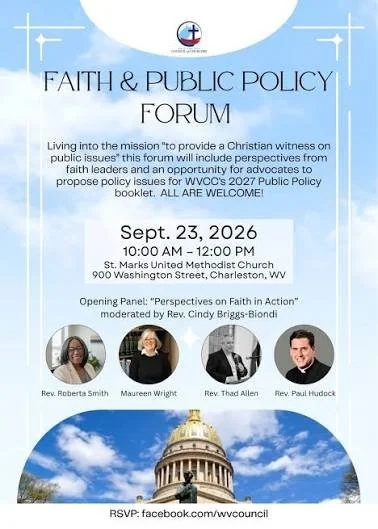
Last month, Eric+ and I represented St. John’s at the West Virginia Council of Churches’ Public Policy Forum, held at St. Mark’s United Methodist Church in Charleston. Several topics were addressed, all centered around the theme of connecting faith communities with public policy at both the state and federal levels.
The Episcopal Diocese of West Virginia is one of 15 different Christian denominations who make up the council’s ecumenical membership. I like to think of the council in terms of high church/low church with the Eastern Orthodox at one end of the spectrum and the Salvation Army at the other, placing our Episcopal diocese near the high-church end.
It’s sometimes an interesting mix, and it takes a lot of discussion among council members to reach unanimity. WVCC cannot take a position on any public policy issue unless all 15 “judicatories” agree, although it is possible that one of them could abstain from taking a stand rather than using its veto power.
The variety of issues that were discussed at this year’s forum included Christian Nationalism, homelessness, racism, climate change, the quality of drinking water in our state, data center accountability, and the poor quality of food provided to West Virginia prisons by a contractor with a questionable reputation.
If you would like to learn how you can help educate our state legislators regarding the council’s stand on any of these issues, visit www.wvcc.org or the council’s Facebook page, or contact the WVCC office directly at 304-344-3141.